- September 02,2026
- -
- Jake Woodward
The Problem With “Units”: How Tipsters Can Manipulate Their Betting Records
If you follow soccer tipsters online, you've probably seen results like these:
+25 units this month.
+80 units this season.
+150 units profit.
At first glance, these numbers look impressive. Using "units" is actually a useful way to track betting performance because it allows bettors with different bankroll sizes to compare results.
But there is a problem.
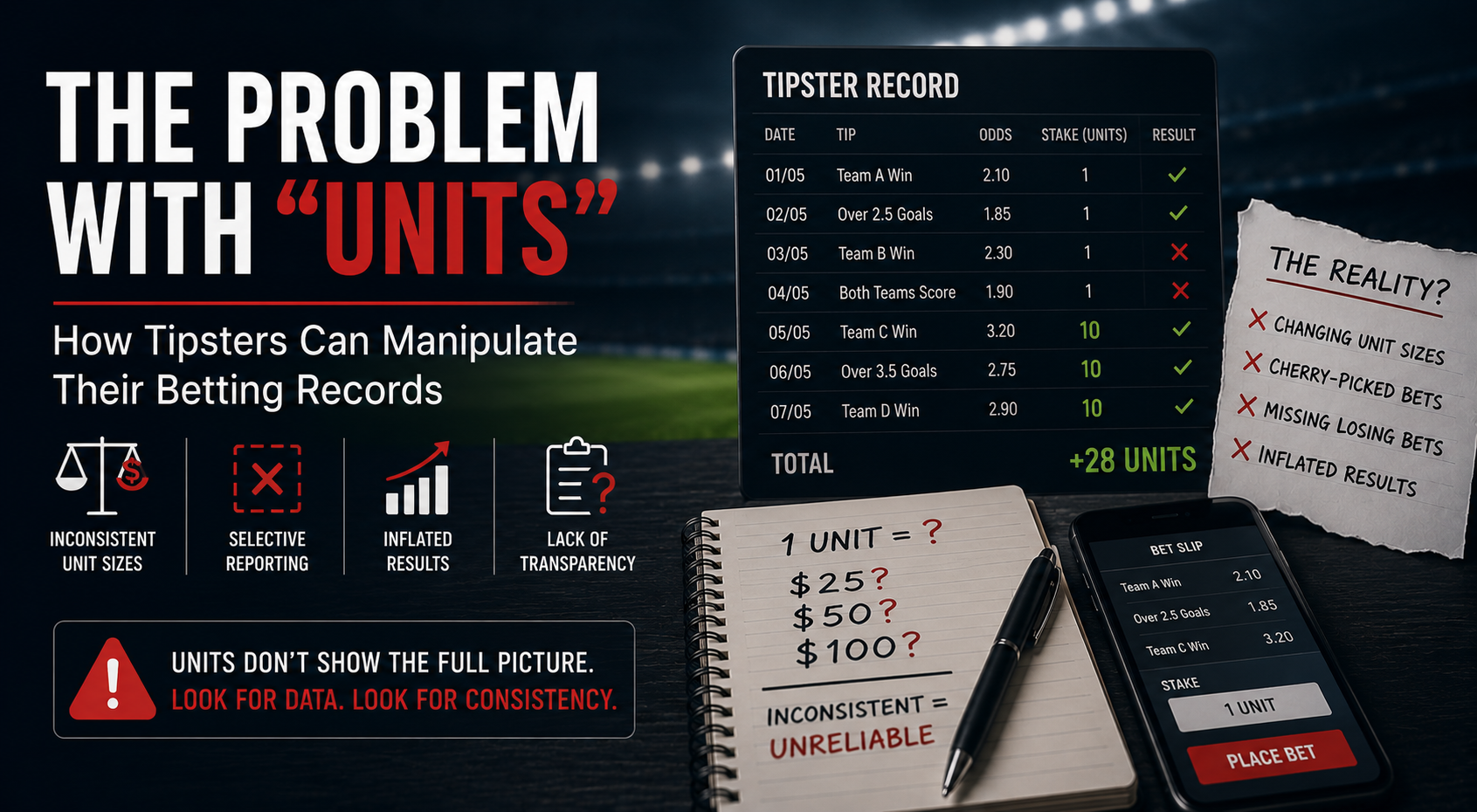
Units only mean something when they are used consistently. When tipsters constantly change stake sizes, selectively report bets, or assign large stakes to winners and smaller stakes to losers, unit-based records can create a very misleading picture of actual performance. Understanding how units work can help you separate transparent betting records from clever marketing.
What Is a Betting Unit?
A unit is a standardized measurement used for betting stakes. Instead of saying:
"I bet $100."
A bettor might say:
"I bet 1 unit."
The actual monetary value of that unit depends on the bettor's bankroll.
For example, if someone defines one unit as $50:
-
0.5 units = $25
-
1 unit = $50
-
2 units = $100
-
3 units = $150
Using units makes it easier to discuss performance without knowing someone's actual bankroll. There is nothing wrong with this system. The problem begins when the rules around those units constantly change.
How Variable Stakes Can Distort Results
Imagine a tipster publishes ten selections.
They lose seven 1-unit bets.
Loss: -7 units.
But they win three bets where they claim to have staked 5 units each. Depending on the odds, those three larger winners could completely overwhelm the losses and produce an impressive-looking unit profit. That isn't automatically manipulation. Some legitimate bettors use variable staking based on their assessment of value.
But bettors should ask an important question:
Were those stake sizes published before the matches started?
If stakes can be changed after results are known, the betting record becomes meaningless.
The Retroactive Stake Problem
One of the easiest ways to manipulate a record is to adjust confidence after the result.
Before kickoff:
"Team A looks good tonight."
After Team A wins:
"That was our 5-unit MAX BET!"
Meanwhile, a losing selection from earlier might quietly remain recorded as a 1-unit bet. Over time, this can create an extremely profitable-looking record even if followers never received those staking instructions beforehand. A transparent tipster should publish the selection, odds, and stake before the event. The record should not change depending on what happens afterward.
The “Max Bet” Problem
Another warning sign is excessive use of high-confidence selections.
Some services regularly advertise:
-
5 UNIT MAX BET
-
10 UNIT LOCK
-
20 UNIT GAME OF THE MONTH
Large unit ratings attract attention because they suggest exceptional confidence. But if stake sizes regularly jump from 1 unit to 10 units, followers should understand exactly how those ratings are determined. Otherwise, one large losing selection can erase many smaller winners. Professional staking should be based on a structured approach to risk, not marketing language.
Selective Reporting Makes Unit Records Even Worse
Unit manipulation becomes especially misleading when combined with selective reporting.
Imagine a tipster posts:
Monday: +4 units
Tuesday: +6 units
Wednesday: +3 units
Then Thursday finishes at -8 units.
Suddenly, there is no daily results post. On Friday, the tipster starts promoting the latest winning selection instead. Anyone casually viewing the account might see mostly profitable days. The complete record tells a different story. This is why all bets matter.
Wins, losses, pushes, and abandoned bets should be recorded consistently.
“+100 Units” Means Very Little Without Context
Suppose two tipsters both claim:
+100 units profit
Their performance could still be completely different.
Tipster A:
-
+100 units
-
2,000 bets
-
1-unit average stake
-
Transparent history
Tipster B:
-
+100 units
-
150 bets
-
Stakes ranging from 1 to 20 units
-
No complete historical record
The headline number is identical. The underlying risk and credibility are not. Whenever you see a large unit profit advertised, don't stop at the headline. Ask how it was generated.
Units Should Be Compared With Total Stakes
Total unit profit alone doesn't show betting efficiency.
Consider:
-
Tipster A stakes 1,000 units and earns 50 units.
-
Tipster B stakes 300 units and earns 45 units.
-
Tipster A made slightly more total profit.
But Tipster B generated nearly the same profit while putting considerably less capital at risk. This is why metrics such as ROI or yield are useful alongside total profit. They provide context around how efficiently the result was achieved.
Look at the Average Odds Too
Strike rate and unit profit should also be considered alongside average betting odds. A tipster betting mostly around odds of 1.40 should naturally win more frequently than someone regularly betting around 2.50. Likewise, a tipster taking larger-priced selections may experience longer losing streaks. Without knowing the odds, stake sizes, and number of bets, a unit-profit figure doesn't tell you enough to properly evaluate performance.
Consistent Staking Makes Records Easier to Trust
One reason flat staking is useful for evaluating tipsters is simplicity. If every selection is recorded at 1 unit, it becomes much harder to manipulate performance through stake sizing. That doesn't mean every professional bettor must use flat stakes. Variable staking can be legitimate. But when variable staking is used, the methodology should be clear and consistent.
For example:
1 unit = standard selection
1.5 units = stronger value
2 units = maximum permitted stake
A narrow, predefined staking range is much easier to evaluate than arbitrary stakes ranging from 1 to 20 units.
Questions to Ask When You See Unit-Based Records
Before being impressed by "+75 units this month," investigate further.
Ask:
-
What does one unit represent?
-
Are stakes published before kickoff?
-
Is the staking system clearly defined?
-
How large can individual stakes become?
-
Are losing bets included?
-
Can historical selections be independently checked?
-
What is the total amount staked?
-
What is the ROI or yield?
-
How many bets produced the reported profit?
-
Are the recorded odds realistically available?
The answers provide much more information than the headline profit.
Verified Records Make Manipulation Harder
This is where verified betting records become particularly valuable.
When selections are recorded before matches begin, tipsters cannot easily:
-
Increase stakes after winners
-
Remove losing selections
-
Change the recorded odds
-
Rewrite historical performance
Verification creates accountability. Instead of asking followers to trust screenshots and claims, the tipster provides a record that can be evaluated objectively. For a tipster marketplace, this distinction is critical. Transparency should be measurable.
Don't Confuse Units With Money
There is another important point.
A tipster claiming +50 units doesn't necessarily mean every follower earned the same amount of money.
One follower's unit might be $10.
Another's might be $100.
Followers may also receive different odds or use different bookmakers. Units are primarily a standardized way of measuring betting performance. They are not a guarantee of financial returns.
What a Trustworthy Tipster Record Should Show
Ideally, bettors should be able to see:
-
Selection
-
Market
-
Published odds
-
Stake in units
-
Date and time
-
Result
-
Profit or loss
-
Total units staked
-
Running profit
-
ROI or yield
-
Meaningful historical sample
Most importantly, this information should be recorded consistently. The less room there is to rewrite history, the more useful the record becomes.
Final Thoughts
Units are not the problem. In fact, they can be one of the clearest ways to track betting performance.
The problem is how they are sometimes used.
Changing stakes without a clear methodology, assigning large units to winners after the result, hiding losing bets, or advertising huge unit profits without showing total stakes can make a poor betting record look much stronger than it really is.
So the next time you see a tipster advertising "+100 units profit," don't immediately ask how much money that represents.
Ask something more important:
How were those 100 units actually made?
Transparent records should be able to answer that question.
In soccer betting, the headline number matters far less than the data behind it.



- Sports Industry Preview
- Soccer League Preview
- Profitable Trends
- Betting Guide
- Betting Help
- Betting Strategy
- Betting System
- Sports Betting
- World Cup
- Betting Tipsters
- Betting Bankroll
- Transfer Window
- Premier League
- Match Reviews
- Footballer Reviews
- Betting Predictions
- Club Reviews
- Manager Reviews
- Betting Odds
- Promotion Reviews
- Betting Trends
- Soccer Betting Tips Video Series
- English Football
- eSports
- Arsenal
- Borussia Dortmund
- Inter milan
- Betting Tips
- World Cup 2018
- Russia
- Italy
- Betting Expert
- Cristiano Ronaldo
- Lionel Messi
- Real Madrid
- France
- Belgium
- Brazil
- Germany
- Paul Pogba
- Marcos Ao??s Corr??a
- Timo Werner
- Aleksandr Golovin
- Sergej Milinkovic-Savic
- Alireza Jahanbakhsh
- Pione Sisto
- Denis Zakaria
- Soccer Tipsters
- Manchester United
- Hull City
- Abou Diaby
- Luc Nilis
- David Busst
- Ryan Mason
- English Premier League
- Middlesbrough F.C.
- Norwich City F.C.
- Sheffield Wednesday F.C.
- Bet Strategy
- Mix Parlay
- AS Monaco FC
- Goal Scoring Trends
- French Ligue 1
- Stade Malherbe Caen
- Stade Rennais F.C.
- Scottish Premier League
- Hibernian F.C.
- Dundee F.C.
- Kilmarnock F.C.
- Celtic F.C.
- Aberdeen F.C.
- Rangers F.C.
- Premier League
- Manchester City
- Barcelona
- FC Bayern Munich
- Carabao Cup
- Real Sociedad
- La Liga
- CD Legan??s
- Deportivo de La Coru?a
- Harry Kane
- England
- Steven Gerrard
- Juventus
- Mohamed Elyounoussi
- Danny Welbeck
- Mattia De Sciglio
- Viniciul Junior
- Flamengo
- Jose Mourinho
- Sir Alex Ferguson
- Chelsea
- Eden Hazard
- Jorginho
- Croatia
- Professional Punters
- Soccer betting tips
- Value Bets
- Betting Odds
- Mark Hughes
- Sportsbook
- Points per game
- PPG
- PPG statistics
- A.S. Roma
- Arsenal F.C.
- Tottenham Hotspur F.C.
- Liverpool F.C.
- Everton F.C.
- FK Partizan
- FK Crvena zvezda
- FC Schalke 04
- A.C. Milan
- Club Atl??tico River Plate
- Derby Della Capitale
- North London Derby
- Merseyside derby
- Eternal Derby
- Ruhr Derby
- Derby della Madonnina
- Superclasico
- World Cup 1998
- Japan
- Colombia
- Denmark
- Euro 2016
- Moscow
- Kaliningrad
- Saint Petersburg
- Nizhny Novgorod
- FC Basel
- Newspaper Betting Tipsters
- Television Betting Tipsters
- Radio Betting Tipsters
- Internet Betting Tipsters
- Soccer Betting Bankroll
- Soccer Betting Expert
- Pierre-Erick Aubameyang
- Fantasy Premier League
- Marko Arnautovic
- Wilfred Zaha
- Chris Wood
- Kyle Walker
- Cezar Azpilicueta
- Seamus Coleman
- Trent Alexander-Arnold
- Sol Bamba
- Leon Goretzka
- Jose Gimenez
- Max Meyer
- Jurgen Klopp
- Stoke City
- Coventry City F.C.
- Bookies
- Bonuses
- Alisson Becker
- Eliquim Mangala
- Anthony Martial
- Luke Shaw
- Toby Alderweireld
- Cesc Fabregas
- Ander Herrera
- Oliver Giroud
- Atletico Madrid
- Sevilla FC
- Ronaldo
- Van Nistelrooy
- Sunderland A.F.C.
- Betting Accumulators
- Mohamed Salah
- Indian Super League
- Pep Guardiola
- Livescores
- Golden Generation
- World Cup 2006
- SSC Napoli
- David De Gea
- Nick Pope
- Allison Becker
- Lukasz Fabianski
- Hugo Lloris
- Ederson Moraes
- VAR
- Dirk Kuyt
- Diego Milito
- Park Ji-Sung
- Thomas Muller
- Soccer Betting Facts
- 1X2
- Handicap Betting
- Total Goals
- SoccerTipsters
- Free Soccer Predictions
- Live Betting
- Bookmaker
- World Cup
- Qatar 2022
- PSG
- Ngolo Kante
- Claude Makelele
- American Football
- E-Sports
- Kathmandu Stadium
- Hillsborough
- CTE
- Chronic Traumatic Encephalopathy
- FIFA
- European Super League
- UEFA
- Neymar
- Professional Footballer
- EPL
- Christian Pulisic
- Lance Armstrong
- Tonya Harding
- Black Sox
- Match Fixing
- Calciopoli
- Formula One Spygate
- Women World Cup
- Series A
- Georgio Chiellini
- Fiorentina
- Bundesliga
- European Handicaps
- Accumulator Bets
- Parlays
- Arbitrage Betting
- Progressive Betting
- Martingale
- Oscar's grind
- Paroli System
- Martindale System
- David Moyes
- Southampton
- Betting Blog
- FA Cup
- SPAL
- Sampdoria
- RB Leipzig
- Champions League
- Betting On Soccer
- Casino Betting
- Teaser Bet
- Betting Bankroll
- Kelly Criterion
- In Play Betting
- Hedging
- Betting Market
- Matched Betting
- Betting Exchange
- Labouchere
- Serie B
- Crotone
- Italy Serie B
- Serie C
- Simeon Nwankwo
- Cittadella
- Liverpool
- UEFA Champions League
- Match predictions
- Paris Saint-Germain
- Atalanta
- Valencia
- Serie A
- Staking method
- Proportional Betting
- Martingale System
- Fibonacci System
- Arbitrage
- Underdogs
- Betting On Underdogs
- Beat The Bookies
- soccer betting
- Spread Betting
- Opening Odds
- Closing Odds
- Betting advice
- Sports Betting Addiction
- Betting Disorder
- Sports Betting in Indonesia
- Indonesia
- Betting On Sports
- Sports Betting in Malaysia
- Ascot Sports
- Betting Guide
- Indo Odds
- Sports Betting In Thailand
- Thailand Sportsbook
- Thailand Casinos
- Asian Bookies
- In-play Betting
- Over/Under
- betting system
- Europa league
- Leicester City
- Benevento Calcio
- Olympics
- Euro Cup
- America Cup
- betting trends
- BTTS
- Villarreal CF
- Betting on Casino
- Casino
- House Edge
- bankroll
- bankroll management
- Betting Bankroll Management
- Coronavirus
- Betting Value
- Asian Handicap
- Parlay
- Betting Probability
- betting on draw
- soccer leagues
- Draw Bets
- Egyptian Premier League
- French Ligue 2
- English League Two
- Correct Score
- Double Chance
- Fixed Odds
- Sportsbook Review
- Bet365
- Statistical Trends
- Marcus Rashford
- Alexandre Lacazette
- Son Heung-Min
- Calvert-Lewin
- Richarlison
- bookmakers
- IMSports
- IMesports
- Betting strategies
- Betting Algorithm
- Invictus
- Accumulator Generator
- Betegy
- AFC Champions League
- Asian Football Champions League
- Galatasaray
- Turkey Super League
- Istanbul Basaksehir
- Trabzonspor
- tipsters
- Smart Punter
- UEFA Euro 2020
- FC Barcelona
- Barça
- Takefusa Kubo
- Hwang Hee-chan
- Takumi Minamino
- Sardar Azmoun
- Erling Haaland
- Jadon Sancho
- Ansu Fati
- Alphonso Davies
- Vinícius Júnior
- Erling Braut Haaland
- Pierre-Emerick Aubameyang
- German Super Cup
- French League Cup
- Constant Kelly
- Football Betting Tips
- Sports Betting Trading
- mathematical expectation
- expected value
- Asian Football Leagues
- Chinese Super League
- K League
- Bet On Corners
- Double Chance Betting
- Sportsbooks
- Red devils
- Betting bonuses
- Rollover
- Welcome Bonuses
- Gerard Deulofeu
- EFL Championship
- Ismaïla Sarr
- Sbotop
- Sbotop Magazine
- Tottenham Hotspur
- Gareth Bale
- Superstitions
- MAXBET
- SBOBET
- M8bet
- Robert Lewandowski
- Odd And Even
- Pinnacle Sports
- Positive Progression
- Bettorclub
- Corner Kicks
- Sheffield United
- Luis Muriel
- Deportivo Cali
- Yankee Bet
- Trixie Combo Bet
- Underdogs Parlay
- Negative Progression
- d'Alembert
- Kevin De Bruyne
- Luka Modric
- Sergio Busquets
- Tony Cross
- Miralem Pjanic
- Frankie de Jong
- Casino games
- Online Slot
- Slot Machine
- RTP
- Romelu Lukaku
- Karim Benzema
- Wayne Rooney
- Derby County
- Dusan Vlahovic
- Vinicius Jr
- MLS
- New England Revolution
- Carles Gil
- Crystal Palace
- Conor Gallagher
- 3-Way Handicap
- Ferran Torres
- Xavi Hernández
- Gabriel Martinelli
- Transfer windows
- Kylian Mbappé
- Franck Kessié
- Ousmane Dembélé
- Paulo Dybala
- Sergio Aguero
- Independiente de Avellaneda
- Diego Maradona
- Luis Díaz
- Trent Alexander Arnold
- Bayern Munich
- Emile Smith Rowe
- Overwatch
- First Person Shooter
- eSports Betting
- Blackjack
- Insurance Bets
- Jude Bellingham
- Sadio Mané
- Jamal Musiala
- Goalkeepers
- Manuel Neuer
- Gianluigi Donnarumma
- Thibaut Courtois
- Nottigham Forest
- Gleison Bremer
- Torino FC
- Hajduk Split
- Torcida Split
- Bayern Leverkusen
- Frenkie de Jong
- Aurélien Tchouaméni
- Tiémoué Bakayoko
- Freiburg
- Nico Schlotterbeck
- Acca
- Betting Algorithms
- Algorithm
- Statistical Betting
- Return On Investment
- ROI
- Betting Markets
- Decimals Odds
- Fractions Odds
- Handicap Odds
- Accumulator Bet
- Relegation
- Both Teams To Score
- Head-To-Head
- Goals Scored
- Dutching
- Early Cashout
- Accumulator Betting
- Over 1.5 Goals
- Total Goal
- Betting Formula
- Decimal Odds
- Both Team To Score
- Underdog
- Goal Scorer System
- Scoreline Betting System
- Handicap Betting System
- Positive Progression System
- Betting Tipsters
- Sports Prediction
- CMD368
- Bookie
- Sports Bookie
- Tipster
- Betting Tipster
- Cover a Bet
- Bet Against Yourself
- Money Management Strategy
- Handicapping Skills
- Handicapping
- Heinz System
- Martingale Betting
- Round Robin
- 1-3-2-6 System
- D’Alembert System
- Predictions
- Betting Exchanges
- Soccer Betting Mistakes
- Betting Mistakes
- Statistical Analysis
- Team Statistics
- Betting Data And Stats
- Historical Results
- Data Driven Strategies
- Sports Analytics
- Analytics
- Sports Betting Analytics
- Betting Analytics
- Deciphering Betting Odds
- Comprehending Betting Odds
- Probability
- Fractional Odds
- Money Line
- Futures Bet
- Prop Bet
- Goliath Bet
- Data Analysis
- Statistics And Data Analysis
- Historical Performances
- Statistical Evaluations
- Betting Strategy
- Betting Model
- Moneyline
- Prop Bets
- Major League Soccer
- Data Management
- 1X On Home
- Fibonacci Strategy
- Martingale Strategy
- Historical Performance
- Sports Betting Misconceptions
- Sports Betting Myths
- Soccer Betting Strategy
- Mathematical
- Statistical Model
- Advanced Analytics
- Performance Indicators
- Predictive Models
- Expected Goals
- Performance Analysis
- Bankroll Goals
- Stop-Loss Strategies
- International Friendly
- Per 90s
- Shooting Percentage
- Ball Possession
- xGChain
- Value Bet
- Compare Odds
- Bet Tracking
- Identifying Trends
- Betting Patterns
- In-Play Bet
- Single Handicap
- Double Handicap
- Quarter Handicap
- Analyzing Statistics
- Historical Data
- Expert Tipster
- Betting Prediction
- Draw No Bet
- Draw Betting
- Data-Driven
- Prop Betting
- Corners
- Own Goal
- Losing Streaks
- Emotional Management
- Analytical Tools
- Fantasy Soccer
- Fantasy Sports
- American Odds
- Implied Probability
- Betting Portfolio
- Diversified Betting Portfolio
- Betting Yield
- Each Way Betting
- Time Management
- Successful Sports Betting
- Head-to-Head Betting
- Lay Betting
- Stacking Techniques
- Stacking
- Insurance Betting System
- Mathematical Betting
- Statistical Analysis And Distributions
- Regression Analysis
- Statistical Significance
- Probability Distributions
- Bayesian Network
- Poisson Distribution
- Binomial Distribution
- Hedge Betting
- Return to Player
- Malaysian Sports Betting
- Form And Statistics
- Leeds United
- Howard Wilkins
- Marco Bielsa
- Malaysia
- Football Betting
- Badminton Betting
- Horse Racing
- Malaysian Super League
- Johor Darul Ta’zim FC
- Sri Pahang FC
- Persatuan Bolasepak Selangor FC
- Psychology Of Betting
- Risk-Taking
- Political Bet
- Indian Football Betting
- Market Trends
- Malaysian Odds
- Betting Formats
- Negative Odds
- Positive Odds
- Mobile Betting
- Artificial Intelligence
- Pritam Kotal
- ATK Mohun Bagan
- Malaysia Online Betting
- Betting Software
- Online Casino
- Wewin
- Slot
- Soccer Tipster
- Data Analytics
- Player Statistics
- Data and Analytics
- Flat Betting
- Eredivisie
- England Championship
- Cash-Out
- Pre-Match Betting
- Margin
- Shots on Target
- Possession Percentage
- Set Piece Stats
- Form Guide
- Line Movement
- Odds Comparison
- Standard Line Movement
- Reverse Line Movement
- Betting Tools
- OddsPortal
- Understat
- Flashscore
- BetStamp
- DNB
- Ligue 1
- Odds Movement
- Sharp Money
- Fake Tipster
- Scam Tipster
- Winning Streaks
- Chasing Losses
- Betting Records
- Betting Screenshots
- Market Liquidity
- Staking Strategy
- Betting Profitability
- Betting Unit
- Professional Tipster
- Line Shopping
- Live Movement
- prop market
- Betting Predictions
- statistical models